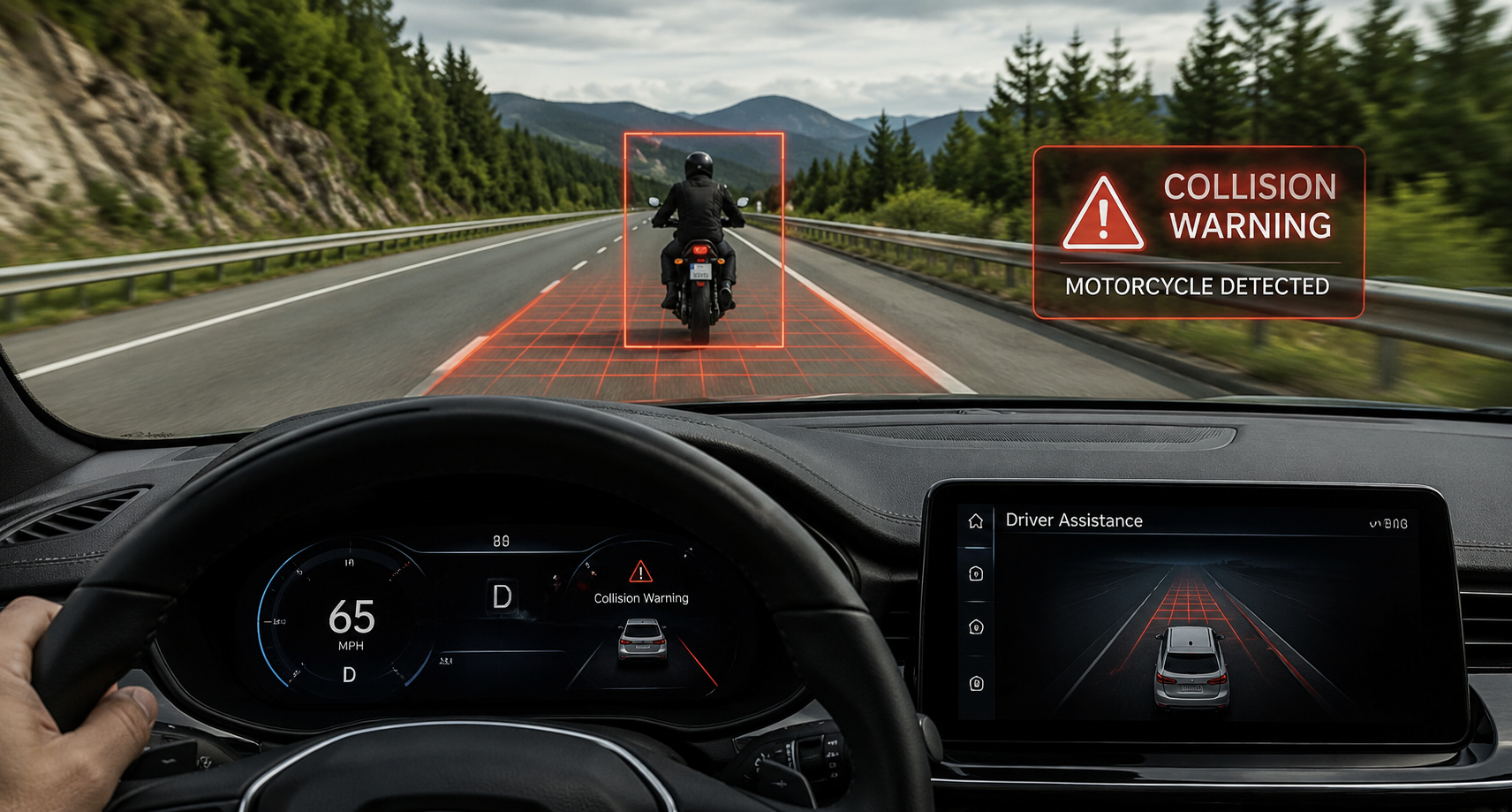
Advanced Driver Assistance Systems (ADAS) are becoming increasingly common on cars, SUVs, and trucks across the United States. Features such as automatic emergency braking, blind-spot monitoring, forward collision warnings, lane-departure alerts, and adaptive cruise control are designed to help drivers recognize hazards and avoid crashes.
For motorcyclists, however, the growth of these technologies creates an important question: how well do vehicle safety systems recognize motorcycles?
Motorcycles are smaller than passenger vehicles and can occupy unusual positions within traffic. That can create challenges for cameras, radar sensors, and other systems designed to identify nearby road users. As ADAS becomes more widespread, understanding these limitations is increasingly important for riders.
What Is ADAS?
Advanced Driver Assistance Systems are technologies designed to assist drivers with specific driving tasks or provide warnings about potential hazards. They do not necessarily make a vehicle autonomous. Instead, they generally provide information, warnings, or limited interventions while the driver remains responsible for controlling the vehicle.
According to the National Highway Traffic Safety Administration, common driver-assistance technologies include automatic emergency braking, blind-spot warning, lane-departure warning, rear cross-traffic warning, and other collision-avoidance features.
These technologies rely on combinations of cameras, radar, ultrasonic sensors, software, and other detection systems. The precise capabilities vary significantly between manufacturers and vehicle models.
Why Motorcycles Can Be Difficult for ADAS to Detect
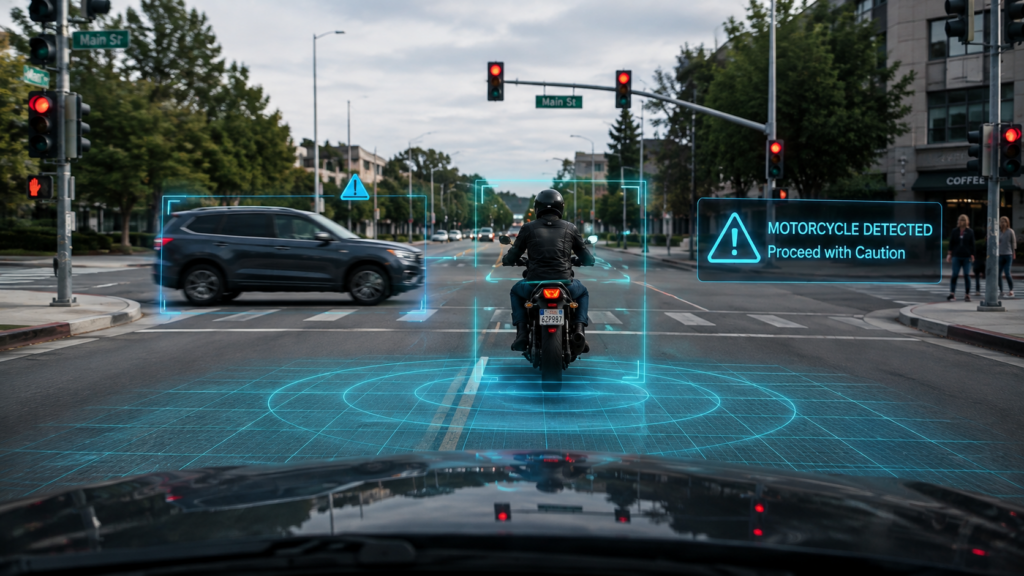
One of the biggest motorcycle safety concerns involving ADAS is detection. A motorcycle has a much smaller visual and radar profile than a typical passenger vehicle. It can also move through traffic differently from a car, particularly when changing lanes, riding near lane boundaries, or traveling alongside stopped or slow-moving vehicles.
Lighting, weather, road geometry, traffic density, and the motorcycle’s position can all influence how a vehicle’s sensors perceive it.
NHTSA has specifically examined the performance of automatic emergency braking systems in relation to motorcycles. Agency research has noted that motorcycles can be more difficult for some AEB systems to detect and has investigated motorcycle detection as part of crash-avoidance technology research.
This does not mean that ADAS is inherently unsafe. Rather, riders and drivers should understand that assistance systems have operating limitations and are not a substitute for active attention.
Blind-Spot Monitoring and Motorcycles
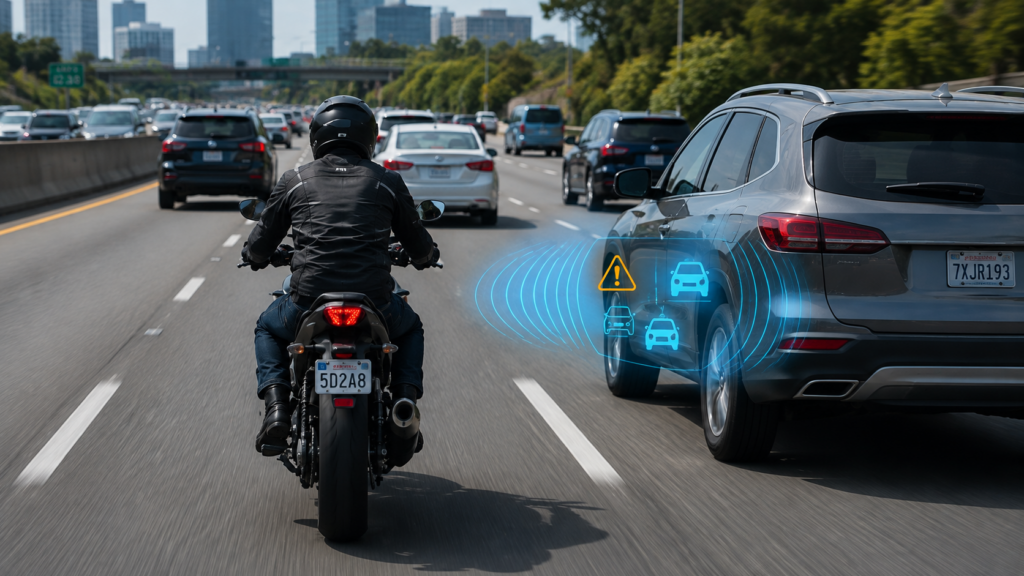
Blind-spot monitoring is particularly relevant to motorcycle safety. These systems generally use sensors to detect vehicles approaching or traveling alongside a car and then warn the driver when a vehicle is in an adjacent blind spot.
The problem is that motorcycles can be harder to identify than larger vehicles.
AAA has tested blind-spot monitoring systems with motorcycles and found that, on average, motorcycles were detected 26% later than other types of vehicles in its testing. Performance also varied between systems and driving conditions.
The findings demonstrate why riders should never assume that a vehicle equipped with blind-spot monitoring will automatically recognize them in every situation.
Automatic Emergency Braking and Motorcycles
Automatic emergency braking, commonly called AEB, is designed to detect an impending collision and apply the vehicle’s brakes when the driver does not respond adequately or quickly enough.
For motorcycle riders, AEB can potentially be beneficial when a car detects a motorcycle ahead and responds appropriately. However, the effectiveness of the system depends on whether the motorcycle is detected, tracked, and correctly classified in time for the system to respond.
NHTSA describes AEB as a technology intended to avoid or reduce the severity of certain forward crashes. The agency has also conducted research involving motorcycles because their characteristics can create different detection challenges than conventional passenger vehicles.
A rider following a vehicle equipped with AEB should therefore continue maintaining a safe following distance. A motorcycle’s stopping distance, road conditions, rider reaction time, and the behavior of the vehicle ahead can all affect what happens during an emergency.
ADAS Can Behave Differently at Intersections
Intersections are already important areas of concern for motorcycle safety. Drivers may turn across a motorcycle’s path, fail to yield, or overlook a motorcycle approaching from another direction.
ADAS technologies can potentially help identify vehicles and pedestrians at intersections, but complex traffic environments can make detection more difficult. Multiple vehicles, turning movements, parked cars, lane markings, pedestrians, and changing traffic signals can create challenging conditions for automated sensing systems.
Motorcyclists should therefore continue approaching intersections defensively rather than assuming that approaching vehicles will automatically recognize them.
What Current Motorcycle Statistics Tell Us
The need for continued awareness is underscored by the latest motorcycle fatality data. The Insurance Institute for Highway Safety reports that 6,228 motorcyclists died in crashes in the United States in 2024.
IIHS also reports that motorcycles are considerably less stable and more difficult for other road users to see than passenger vehicles. Because riders do not have an enclosed occupant compartment, crashes can produce severe consequences even when the initial vehicle contact appears relatively minor.
These statistics reinforce an important point: technology may provide another layer of protection, but motorcycle safety still depends heavily on visibility, awareness, appropriate speed, protective equipment, and defensive riding.
Our Motorcycle Safety category provides additional information about safety practices, equipment, and crash prevention.
How ADAS May Change Driver Behavior
ADAS can influence motorcycle safety in another way: it may change how drivers interact with traffic.
A driver who regularly relies on blind-spot warnings or collision alerts may become accustomed to receiving assistance from the vehicle. However, manufacturers and safety organizations generally emphasize that these systems are designed to assist an attentive driver rather than replace observation.
The NHTSA guidance on driver-assistance technologies explains the role of systems such as AEB and blind-spot warning while emphasizing their limitations.
For motorcycle riders, this means assuming that a driver may still fail to see them is often the safer approach. A rider should avoid lingering in another vehicle’s blind spot and should remain prepared for sudden lane changes or turns.
Why Riders Should Not Rely on ADAS
ADAS is developing quickly, but no system can eliminate every motorcycle crash risk. Sensors can have limitations, software can misinterpret situations, and system performance can vary depending on the vehicle, environment, and circumstances.
Riders should continue using defensive riding techniques even when surrounded by newer vehicles equipped with advanced safety features.
Useful habits include maintaining a visible lane position, watching the front wheels of nearby vehicles for signs of movement, leaving enough space to react, and avoiding sudden maneuvers whenever possible.
The NHTSA motorcycle safety guidance recommends that riders remain alert, make themselves visible, use appropriate protective equipment, and understand the challenges associated with operating a motorcycle in traffic.
How Connected Technology Could Improve Motorcycle Detection
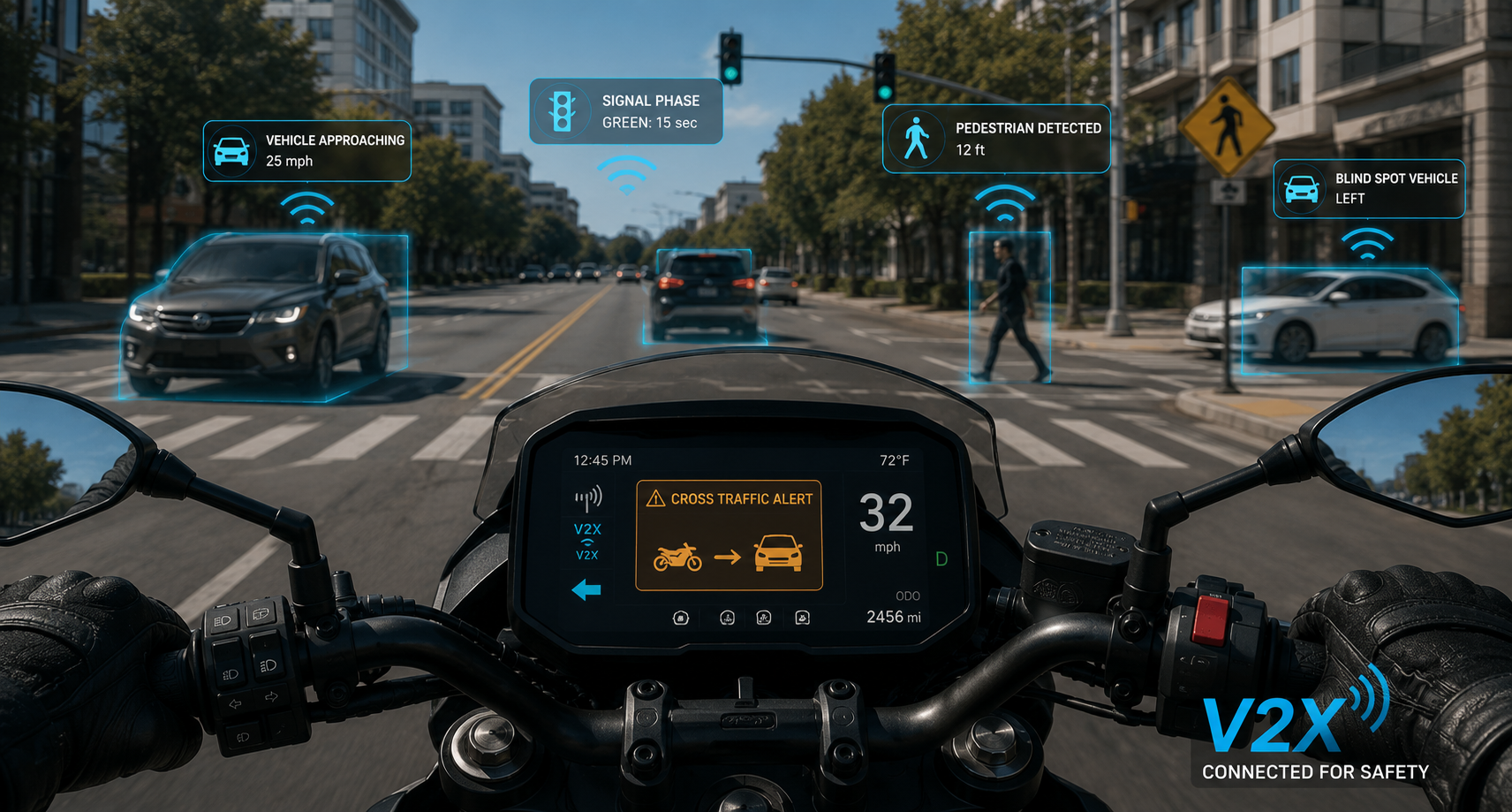
ADAS is only one part of the larger movement toward connected transportation. Vehicle-to-Everything, or V2X, technology can allow vehicles and infrastructure to exchange information beyond what an individual camera or radar sensor can observe.
The U.S. Department of Transportation’s V2X program describes technologies that can support communication between vehicles, infrastructure, and other road users.
This could eventually complement conventional ADAS by giving vehicles additional information about motorcycles that may not be directly visible to their sensors. For example, a connected motorcycle could potentially communicate its location and movement to nearby equipped vehicles or roadside systems.
Our article on smart motorcycle connectivity and V2X technology provides a deeper look at how connected systems may influence future crash prevention.
What Riders Should Watch For in 2026
As more vehicles receive ADAS features, riders should become familiar with the technologies they are likely to encounter on the road. A vehicle may be capable of detecting a motorcycle, but that does not mean detection will occur under every condition.
Drivers may also receive warnings about motorcycles without realizing how the system works or how quickly it responds. Riders should therefore continue anticipating unexpected lane changes, braking, turns, and other movements from surrounding traffic.
Technology should be treated as an additional safety layer rather than a guarantee of protection.
The Future of ADAS and Motorcycle Safety
The relationship between motorcycles and ADAS is likely to receive more attention as automated and connected vehicles become increasingly common. NHTSA has already conducted and supported research examining motorcycle crash-avoidance technologies and rider perspectives.
The U.S. Department of Transportation’s motorcycle crash-avoidance technology review specifically sought rider feedback about the use and availability of advanced motorcycle crash-avoidance technologies.
Future developments could include better motorcycle recognition, improved sensor fusion, enhanced blind-spot detection, motorcycle-specific testing procedures, and greater integration between connected motorcycles and surrounding vehicles.
Our existing coverage of new motorcycle safety technologies provides additional context about how rider-assistance technology is evolving.
Final Thoughts
Advanced Driver Assistance Systems have the potential to make roads safer, but their growing presence also creates new questions for motorcycle riders. Smaller vehicle size, blind spots, complex traffic environments, and differences between individual systems can affect how effectively a car’s technology recognizes a motorcycle.
Current research shows that motorcycle detection is an important consideration when evaluating ADAS. As these systems continue to evolve, better testing and motorcycle-specific technology could help close some of the gaps.
Until then, riders should continue to prioritize visibility, space, awareness, appropriate speed, and defensive riding. Technology can provide useful assistance, but it should never replace the rider’s attention to the road.